
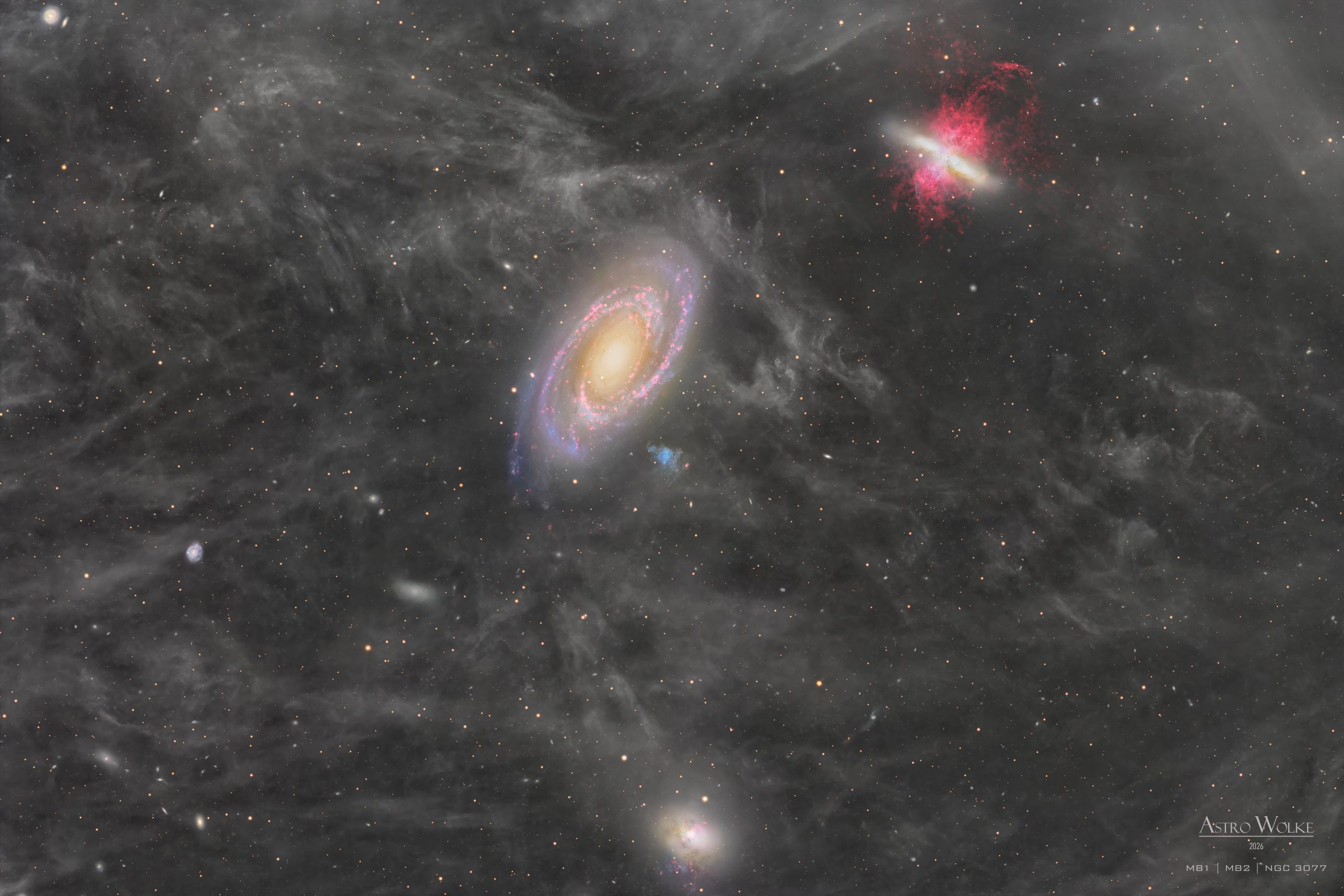
In the constellation Ursa Major, this image shows one of the most impressive galaxy groups in our local universe: M81, M82, and NGC 3077 – all about 12 million light-years away. These three galaxies are closely bound by gravity and have passed near one another several times in the past. The consequences of those encounters are still visible today.
M81, at the center of the image, is a classic spiral galaxy with a bright central bulge and delicate spiral arms. In its outer regions, faint reddish star-forming areas can be seen, arranged like pearls along the arms. In the upper right lies M82, the famous “Cigar Galaxy.” During a close encounter with M81 about 500 million years ago, it was so strongly disturbed that it entered an intense phase of star formation. Powerful stellar winds and supernova explosions now drive gas out of the galaxy, visible here as reddish outflows extending perpendicular to its disk.
At the bottom of the image is NGC 3077, a smaller, more irregular-looking galaxy that was also disturbed during a close passage by M81 about 300 million years ago.
The delicate white wisps in the image are galactic cirrus, or Integrated Flux Nebula (IFN) — extremely faint dust within our own Milky Way, softly illuminated by the combined starlight of the galaxy.
This galaxy group is a striking reminder that galaxies are not isolated islands in space, but dynamic systems that continuously shape and transform one another.
Im Sternbild Großer Bär zeigt dieses Bild eine der eindrucksvollsten Galaxiengruppen unseres lokalen Kosmos: M81, M82 und NGC 3077 – alle rund 12 Millionen Lichtjahre entfernt. Diese drei Galaxien sind gravitativ eng miteinander verbunden und haben sich in der Vergangenheit mehrfach nahe passiert. Die Folgen dieser Begegnungen sind bis heute sichtbar.
M81 (in der Bildmitte) ist eine klassische Spiralgalaxie mit hellem Zentralbulge und feinen Spiralarmen. In den Außenbereichen erkennt man zarte, rötliche Sternentstehungsgebiete, die in den Armen wie Perlen aufgereiht sind. Rechts oben liegt M82, die berühmte „Zigarrengalaxie“. Sie wurde durch die Wechselwirkung mit M81 bei einem Vorbeiflug vor 500 Millionen Jahren so stark gestört, dass im Inneren eine extreme Sternentstehungsphase abläuft. Dabei treiben Sternwinde und Supernovae Gas aus der Galaxie hinaus – sichtbar als rötlich leuchtende Ausströmungen senkrecht zur Scheibe.
Unten im Bild steht NGC 3077, eine kleinere, unregelmäßig wirkende Galaxie, die ebenfalls bei einem Vorbeiflug an M81 vor 300 Millionen Jahren gestört wurde.
Die zarten weißen Schleier im Bild sind galaktischer Zirrus beziehungsweise Integrated Flux Nebula (IFN) – extrem lichtschwacher Staub in unserer eigenen Milchstraße, der vom gesammelten Sternenlicht der Galaxis schwach angestrahlt wird. Diese Galaxiengruppe ist ein sichtbarer Hinweis darauf, dass Galaxien keine isolierten Inseln sind, sondern sich gegenseitig formen und verändern.
Details
Total Integration: 54h 20’
H: 99×300 (16h 35’ ) 04|05.03.2025 / 01|03|04.03.2026
L-mono: 361x300s (30h 5’) 03|17|18.02./02.03.2025 / 21|22.03.2026
R 36x300s (3h) 19.01.2025
G 31x300s (2h 35’) 19.01.2025
B 25x300s (2h 5’) 01.02.2025
FOV: 2.14° x 1.43°
Pixel scale: 1.29″/pixel
Dithering: 5px/2pic
Gain: 100
Sensor temperature: -10°C
Recording: ZWO ASI 2600MM PRO DUO
Filter: Baader L-RGB 50×50 | Baader Ha 2‘‘ Highspeed
Optics: RASA 11″ V2
Guiding: ASI 220
Mount: iOptron CEM 120
Control: ZWO ASIAIR Plus
Software: PixInsight & Photoshop
Darks: 20
Flats: 20
Flat-Darks: 20