
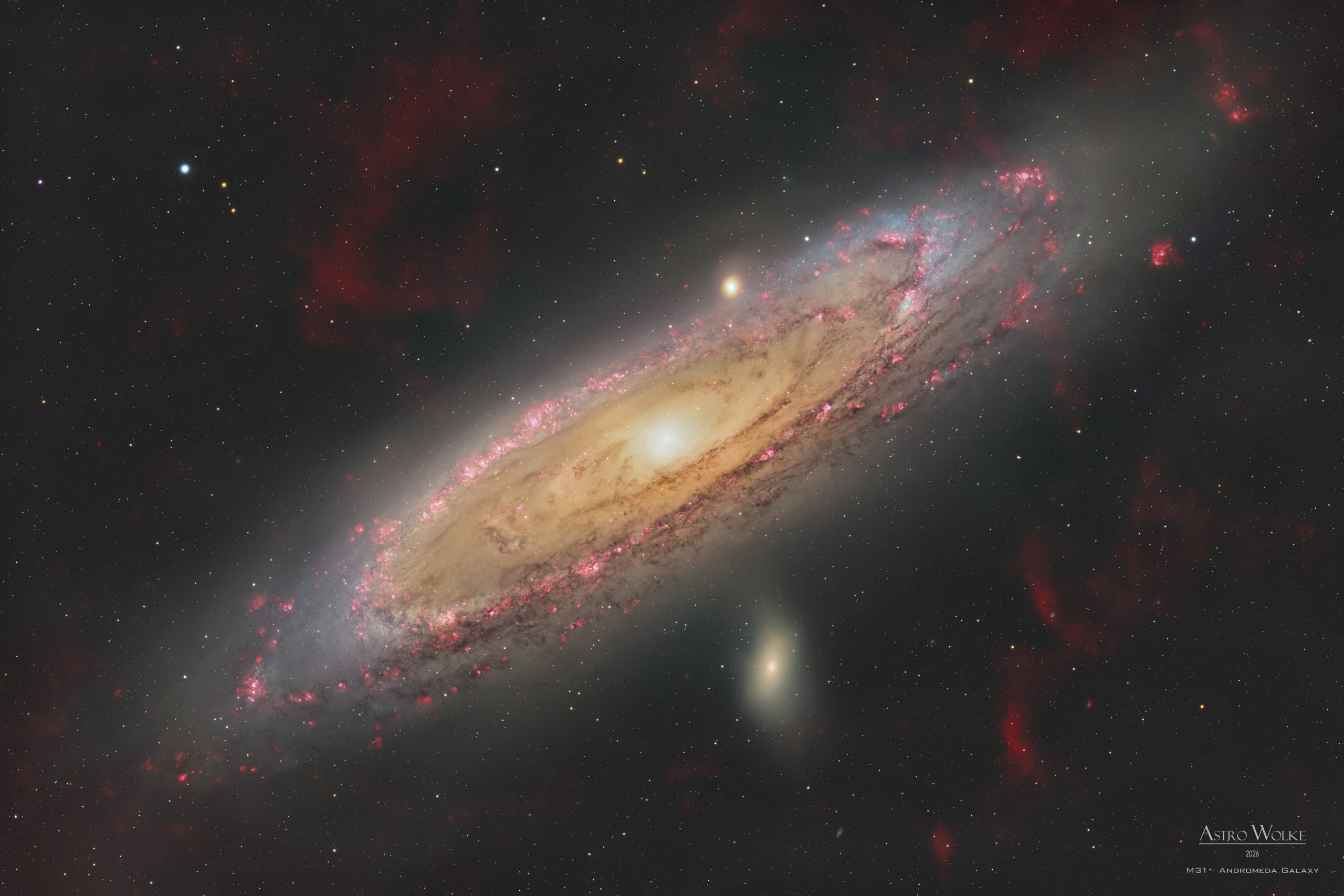
At a distance of 2.5 million light-years lies our cosmic neighbour — the Andromeda Galaxy.
M31 is a vast spiral galaxy, similar to our Milky Way. In this image, the bright yellowish core, the dark dust lanes in the spiral arms, and numerous reddish regions of ionised hydrogen are clearly visible. These are areas where new stars are forming — comparable to the star-forming regions in our own galaxy.
Two companion galaxies can also be seen: M32, the compact bright galaxy close to M31’s centre, and M110, the larger, more diffuse elliptical galaxy below the Andromeda Galaxy. Together, they form a small galactic system — similar to the Milky Way and its companion galaxies.
M31 has been known for many centuries. The Persian astronomer Abd al-Rahman al-Sufi described it as early as the year 964 as a “small cloud”. For a long time, objects like this were thought to be nebulae within our own Milky Way. It was only in the early 20th century that Edwin Hubble, using variable stars in M31, showed that Andromeda lies far beyond the Milky Way. This made it clear: our galaxy is not the entire Universe — it is just one of countless galaxies.
The Andromeda Galaxy is not only our great neighbour — it is also moving towards us. Relative to the Milky Way, it is approaching at about 110 kilometres per second. In several billion years, the two galaxies will merge.
In einer Entfernung von 2,5 Millionen Lichtjahren befindet sich unsere Nachbarin — die Andromedagalaxie.
M31 ist eine riesige Spiralgalaxie, ähnlich wie unsere Milchstraße. In diesem Bild erkennt man deutlich den hellen gelblichen Kern, die dunklen Staubbänder in den Spiralarmen und zahlreiche rötliche Bereiche aus ionisiertem Wasserstoff. Dort entstehen neue Sterne — vergleichbar mit den Sternentstehungsgebieten in unserer eigenen Galaxis.
Auch zwei Begleitgalaxien sind sichtbar: M32, die kompakte helle Galaxie nahe am Zentrum von M31, und M110, die größere, diffusere elliptische Galaxie unterhalb der Andromedagalaxie. Zusammen bilden sie ein kleines galaktisches System — ähnlich wie die Milchstraße mit ihren Begleitgalaxien.
Schon seit vielen Jahrhunderten ist M31 bekannt. Der persische Astronom Abd al-Rahman al-Sufi beschrieb sie bereits im Jahr 964 als „kleine Wolke“. Lange Zeit hielt man solche Objekte für Nebel innerhalb unserer Milchstraße. Erst Anfang des 20. Jahrhunderts zeigte Edwin Hubble anhand veränderlicher Sterne in M31, dass Andromeda weit außerhalb der Milchstraße liegt. Damit wurde klar: Unsere Galaxis ist nicht das ganze Universum — sie ist nur eine von unzähligen Galaxien.
Die Andromedagalaxie ist nicht nur unsere große Nachbarin — sie kommt uns auch näher. Relativ zur Milchstraße bewegt sie sich mit etwa 110 Kilometern pro Sekunde auf uns zu. In einigen Milliarden Jahren werden beide Galaxien miteinander verschmelzen.
Details
Total Integration: 31h 15‘
H: 106x300s (8h 50’) – 02.10.2025
L-mono: 183x300s (15h 15’) – 30.09/01.10.2025 82x/101x
L-RGB: 86x300s (7h 10’) – 02.10.2025
FOV: 3.3° x 2.2°
Pixel scale: 1.9″/pixel
Dithering: 2 pixels every 5 images
Gain: 100
Sensor temperature: -10°C
Recording: ZWO ASI 2600MM DUO / ZWO ASI 2600MC
Filter: Baader Luminance 2‘‘ / Baader Ultra Narrowband 2‘‘
Optics: Askar SQA85 (mono) / TS Optics 76 EDPH (RGB)
Guiding: ASI 120 (ZWO OAG-L)
Mount: ZWO AM5N (mono) / Celestron AVX (RGB)
Control: ZWO ASIAIR Plus (mono) / ZWO ASIAIR MINI (RGB)
Software: PixInsight + Photoshop
Darks: 30
Flats: 20
Flat-Darks: 20