
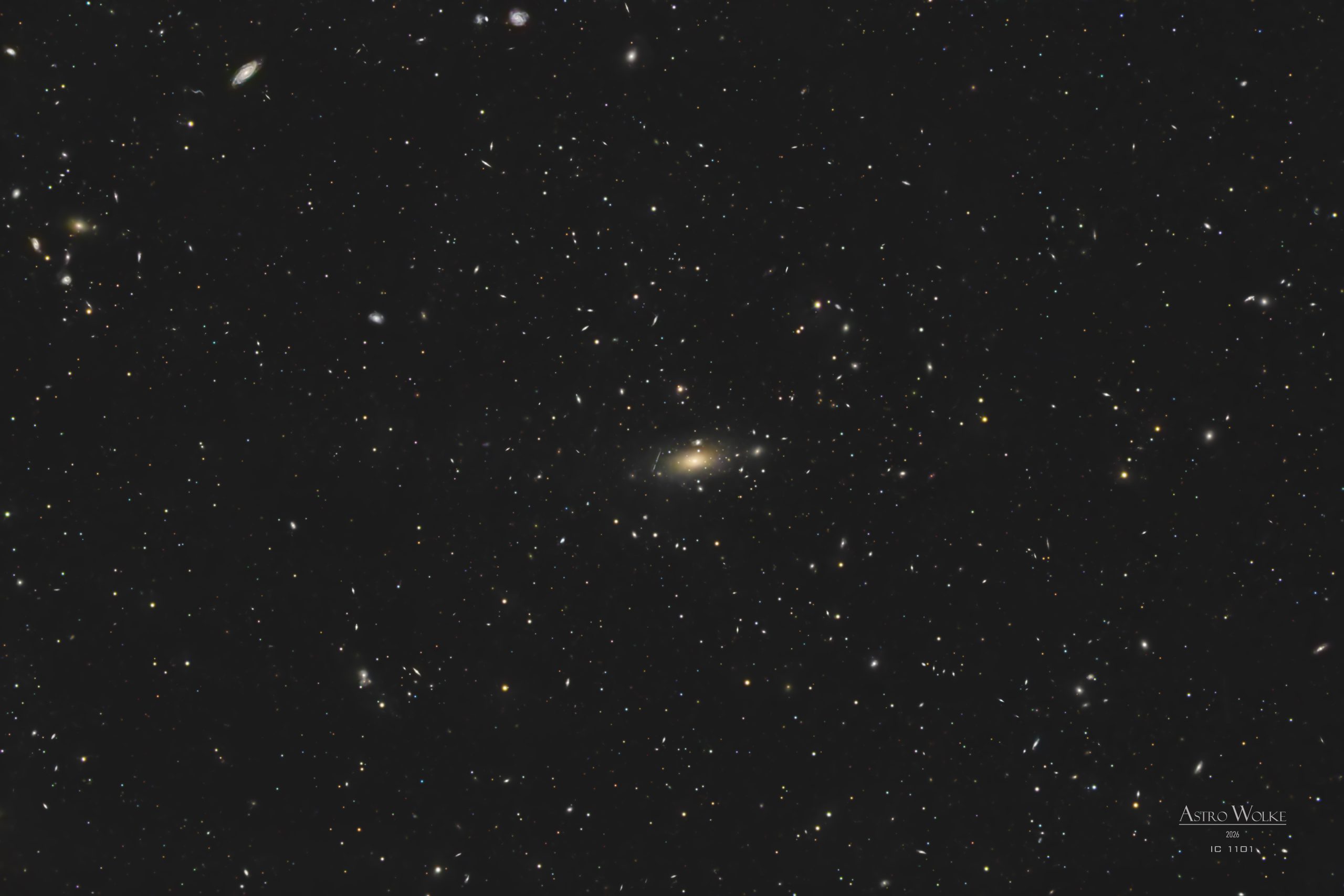
IC 1101 is the dominant galaxy at the centre of the massive galaxy cluster Abell 2029. With a redshift of z = 0.077, its light has travelled for roughly one billion years before reaching us.
IC 1101 is an extreme example of a giant cD galaxy, surrounded by an enormous, diffuse stellar halo. Recent ultra-deep observations indicate a diameter of around 520 kiloparsecs – about 1.7 million light-years – making it the largest galaxy currently known by measured stellar extent. Its stellar mass is estimated at approximately 3.4 trillion times the mass of the Sun.
At its centre lies an exceptionally large depleted core, probably shaped by repeated galaxy mergers and the interaction of supermassive black holes over billions of years. When we look at IC 1101 today, we are therefore seeing a galaxy not as it is now, but as it appeared roughly one billion years ago – long before complex life developed on Earth.
IC 1101 ist die dominierende Galaxie im Zentrum des massereichen Galaxienhaufens Abell 2029. Mit einer Rotverschiebung von z = 0,077 war ihr Licht rund eine Milliarde Jahre unterwegs, bevor es uns erreichte.
IC 1101 ist ein extremes Beispiel einer riesigen cD-Galaxie, die von einem ausgedehnten, diffusen Sternenhalo umgeben ist. Neuere sehr tief belichtete Untersuchungen deuten auf einen Durchmesser von etwa 520 Kiloparsec – rund 1,7 Millionen Lichtjahren – hin. Damit gehört IC 1101 zu den größten bekannten Galaxien, deren stellare Ausdehnung vermessen wurde. Ihre Sternmasse wird auf ungefähr 3,4 Billionen Sonnenmassen geschätzt.
Im Zentrum befindet sich ein außergewöhnlich großer, sternarmer Kernbereich. Dieser ist vermutlich durch zahlreiche Verschmelzungen mit anderen Galaxien sowie durch die Wechselwirkung supermassereicher Schwarzer Löcher über Milliarden Jahre hinweg entstanden.
Wenn wir IC 1101 heute betrachten, sehen wir die Galaxie daher nicht so, wie sie heute aussieht, sondern so, wie sie vor etwa einer Milliarde Jahren erschien – lange bevor sich komplexes Leben auf der Erde entwickelte.
Details
Total Integration: 12h 15‘
R: 32x180s (1h 36’) – 28.04.2026
G: 30x180s (1h 30’) – 28.04.2026
B: 30x180s (1h 30’) – 28.04.2026
L: 153x180s (7h 39’) – 26.04.|09.05.2026
FOV: 0.9° x 0.6°
Pixel scale: 0.5″/pixel
Dithering: 2 pixels every image
Gain: 100
Sensor temperature: -10°C
Recording: ZWO ASI 2600 MM P25
Filter: Baader CMOS 2’’ L-RGB
Optics: Celestron C8EHD + Celestron Reducer 0.7x
Guiding: ZWO ASI 220 MM / ZWO OAG-L
Mount: iOptron CEM70
Control: ZWO ASIAIR Plus
Software: PixInsight + Photoshop
Darks: 30
Flats: 20
Flat-Darks: 20