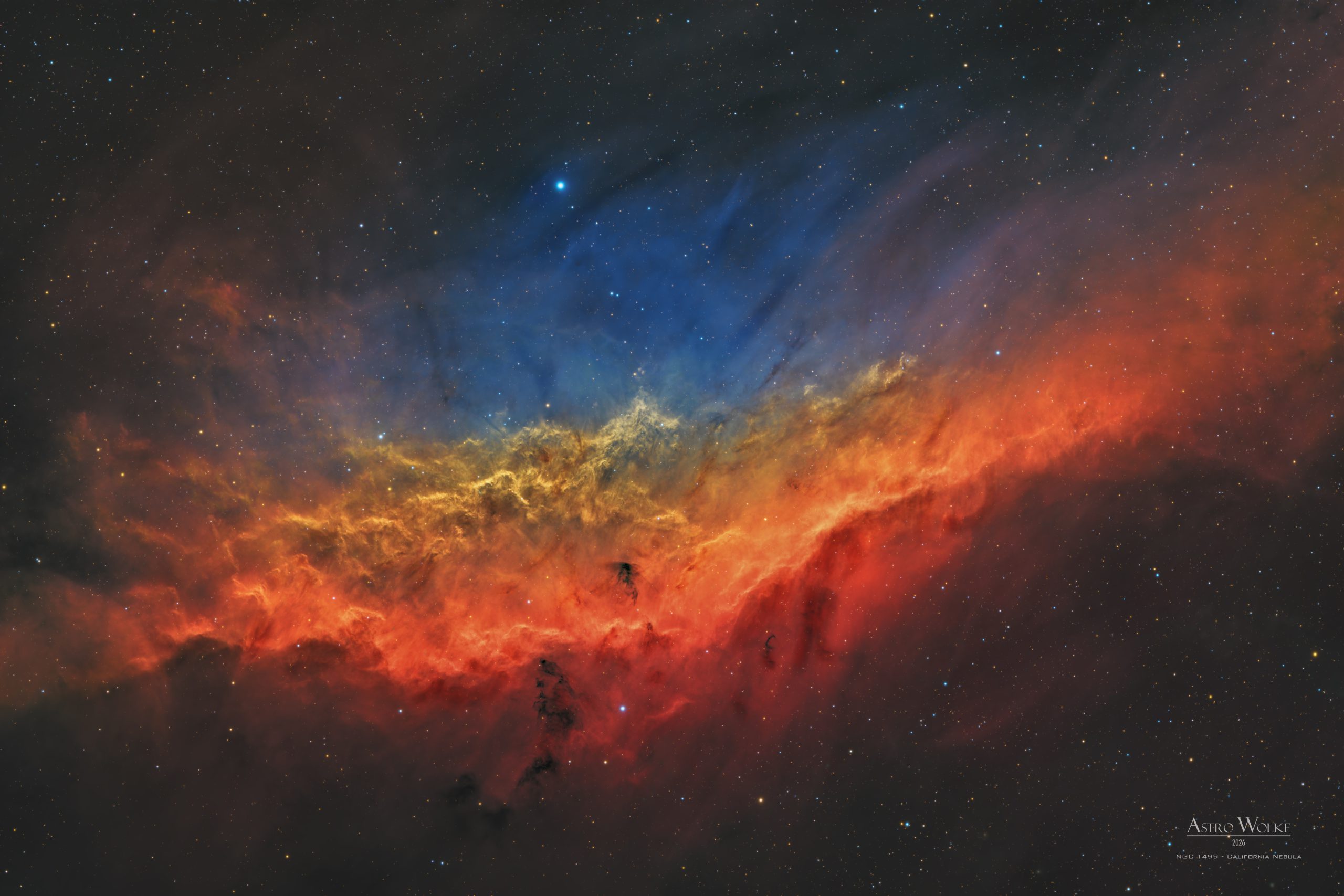
In the constellation Perseus lies the emission nebula NGC 1499 (“the California Nebula”). Dark dust filaments absorb light and appear as silhouettes against the glowing gas—tracing dense material from which new stars can form over time in regions like this. NGC 1499 is roughly about 1,000 light-years away and is exceptionally large on the sky, spanning around 2.5° in length (about five full Moon diameters).
Im Sternbild Perseus liegt der Emissionsnebel NGC 1499 („California Nebula“). Dunkle Staubfilamente absorbieren Licht und zeichnen sich als Silhouetten vor dem leuchtenden Gas ab – sie markieren dichte Materie, aus der sich in solchen Regionen langfristig neue Sterne bilden können. NGC 1499 liegt grob in der Größenordnung von etwa 1.000 Lichtjahren Entfernung und ist am Himmel mit rund 2,5° Länge außergewöhnlich groß (etwa fünf Vollmonddurchmesser).
Details
Total Integration: 22h 30‘
S: 80x300s (6h 40’) – 26.12.2025
H: 81x300s (6h 45’) – 25.12.2025
O: 105x300s (8h 45’) – 24.12.2025
L-RGB: 40x30s (20’) – 25.12.2025
FOV: 3.3° x 2.2°
Pixel scale: 1.9″/pixel
Dithering: 2 pixels every 5 images
Gain: 100
Sensor temperature: -10°C
Recording: ZWO ASI 2600MM DUO / ZWO ASI 2600MC
Filter: Baader Luminance 2‘‘ / Baader Ultra Narrowband 2‘‘
Optics: Askar SQA85 (mono) / TS Optics 76 EDPH (RGB)
Guiding: ASI 120 (ZWO OAG-L)
Mount: ZWO AM5N (mono) / Celestron AVX (RGB)
Control: ZWO ASIAIR Plus (mono) / ZWO ASIAIR MINI (RGB)
Software: PixInsight + Photoshop
Darks: 30
Flats: 20
Flat-Darks: 20
Comments are closed