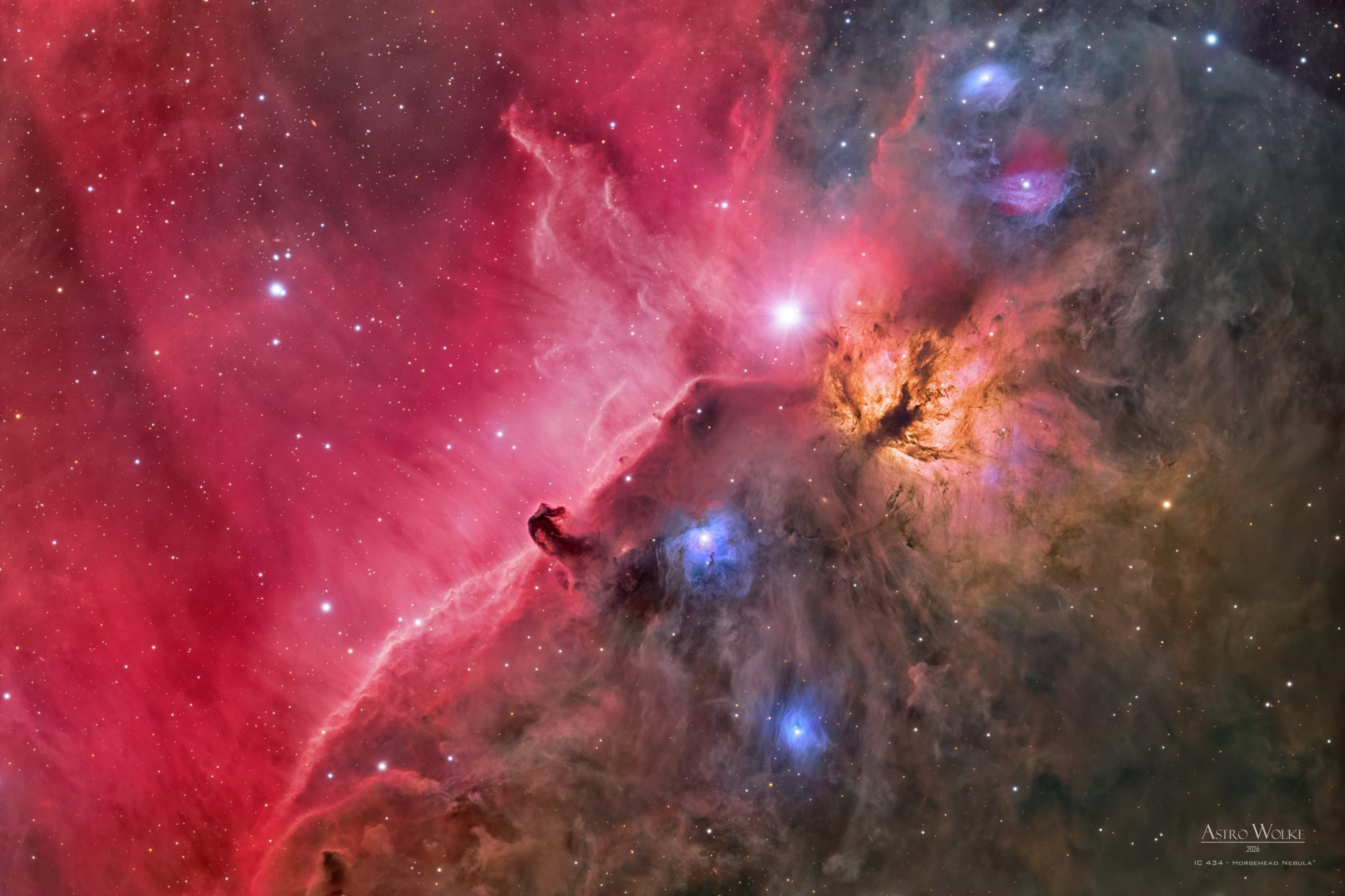
In the constellation Orion, just south of the belt star Alnitak, lies one of the most famous regions in the sky: the Horsehead and Flame Nebula complex. This image shows the reddish emission nebula IC 434 with the dark silhouette of the Horsehead Nebula (Barnard 33), and to the right the bright Flame Nebula NGC 2024.
IC 434 is an extended cloud of hydrogen gas about 1,300 light-years away. The intense radiation from the hot stars in Orion’s Belt excites the gas and makes it glow in the characteristic H-alpha red that dominates much of the image. In front of it, like a shadow, lies the dense dust pillar of the Horsehead Nebula, whose shape really does resemble the head and neck of a horse.
NGC 2024, the Flame Nebula, is another active star-forming region. Hidden inside is a young star cluster whose radiation makes the surrounding gas and dust shine. The bright yellow-orange and bluish areas in the image arise from a mix of emission and reflection nebulae, crossed by dark dust lanes that partly block the light.
Im Sternbild Orion, südlich des Gürtelsterns Alnitak, liegt eine der bekanntesten Himmelsregionen überhaupt: der Pferdekopf- und Flammennebel. Das Bild zeigt den rötlich leuchtenden Emissionsnebel IC 434 mit der dunklen Silhouette des Pferdekopfnebels (Barnard 33) sowie rechts daneben den hellen Flammennebel NGC 2024.
IC 434 ist eine ausgedehnte Wasserstoffwolke in rund 1.300 Lichtjahren Entfernung. Die energiereiche Strahlung der heißen Sterne im Oriongürtel regt das Gas zum Leuchten an – das charakteristische H-alpha-Rot, das große Teile der Aufnahme prägt. Davor schiebt sich wie ein Schatten die dichte Staubsäule des Pferdekopfnebels, deren Form tatsächlich an Kopf und Hals eines Pferdes erinnert.
NGC 2024, der Flammennebel, ist eine weitere aktive Sternentstehungsregion. Im Inneren verbirgt sich ein junger Sternhaufen, dessen Strahlung die umgebende Gas- und Staubwolke zum Leuchten bringt. Die hellen, gelb-orange und bläulich schimmernden Bereiche im Bild entstehen durch das Zusammenspiel von Emissions- und Reflexionsnebeln sowie dunklen Staubbändern, die das Licht teilweise verschlucken. Zusammen zeigt diese Himmelsregion eindrucksvoll, wie eng Staub, Gas und junge Sterne miteinander verbunden sind – ein kosmisches Labor für die Geburt neuer Sonnen und vielleicht zukünftiger Planetensysteme.
Der Pferdekopfnebel ist eines der bekanntesten Objekte am Himmel. Seine markante Silhouette vor dem leuchtenden Wasserstoffhintergrund macht ihn seit den Anfängen der Astrofotografie zu einem Lieblingsmotiv – spektakuläre Aufnahmen, unter anderem mit dem Hubble-Weltraumteleskop im Infrarotlicht, haben ihn weltweit berühmt gemacht.
Details
Total Integration: 22h 39’
H: 32×300 (2h 40’ ) 30.12.2025
L-mono: 314x60s (5h 14’) 26.12.2025|16.01.2026
L-mono: 116x300s (9h 40’) 16.|18.01.2026
L-RGB: 85x60s (1h 25’) 26.12.2025
L-RGB: 44x300s (3h 40’) 16.01.2026
FOV: 2.16° x 1.44°
Pixel scale: 1.26″/pixel
Dithering: 5px/2pic
Gain: 100
Sensor temperature: -10°C
Recording: ZWO ASI 2600MM PRO DUO | ZWO ASI 2600 MC Pro
Filter: Baader Luminance 50×50 | 2‘‘ / Baader Ha 2‘‘ Highspeed
Optics: RASA 11″ V2 | TS 76 EDPH
Guiding: ASI 220 | ASI 120
Mount: iOptron CEM 120 | Celsetron AVX
Control: ZWO ASIAIR Plus | ASIAIR MINI
Software: PixInsight & Photoshop
Darks: 20
Flats: 20
Flat-Darks: 20
Comments are closed