
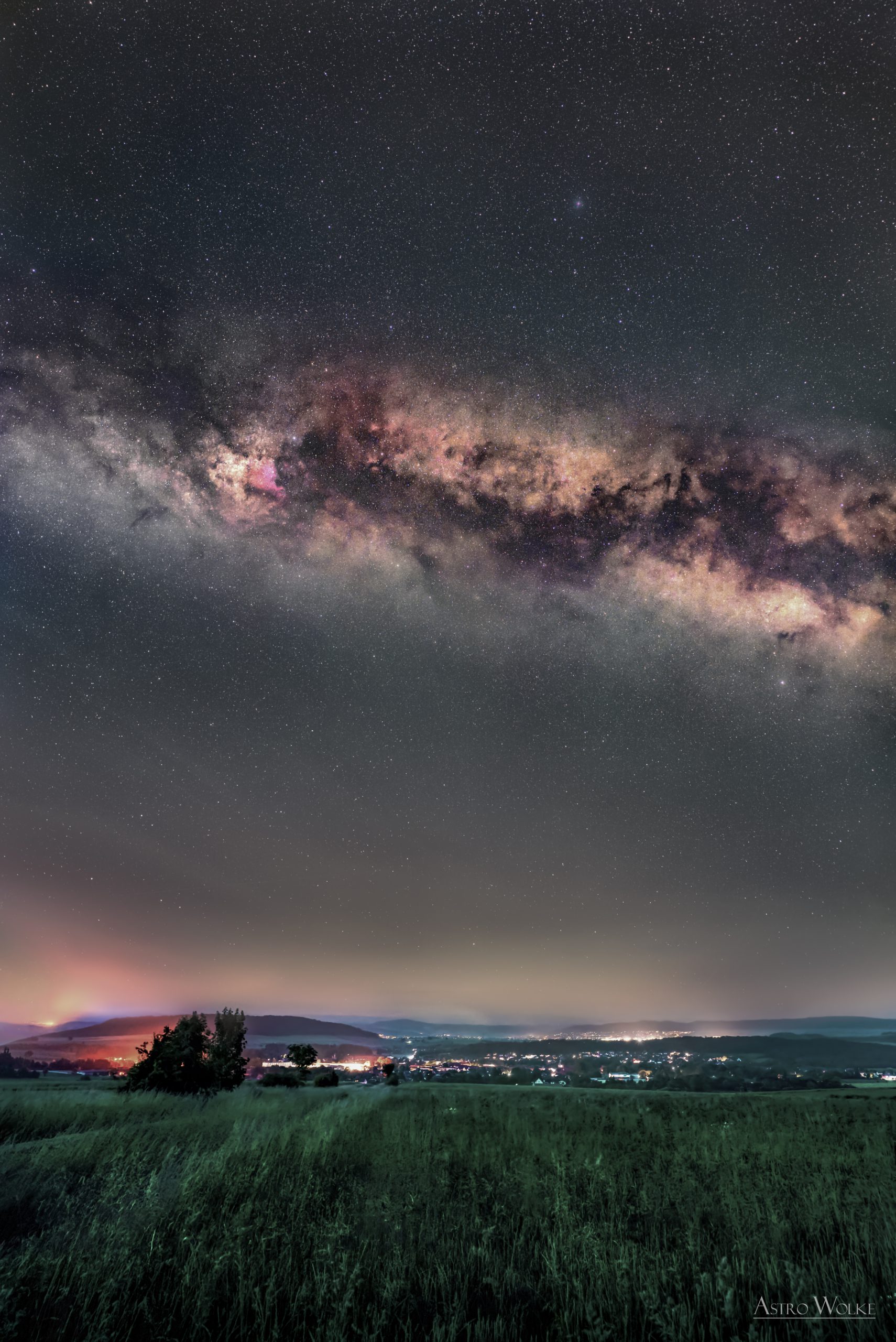
On clear summer nights, one of the most impressive sights in the night sky can be seen above our region: the Milky Way. The photograph shows the view from the Weper hills across Moringen towards Northeim. Above the landscape stretches the bright band of our home galaxy, crossed by dense star fields, dark dust lanes and faint reddish glowing gas clouds.
What can be seen here is not a single nebula or star cluster, but a view into the disc of our own galaxy. The Milky Way contains several hundred billion stars, as well as vast amounts of gas and dust. From Earth, it appears as a milky band because we live within it and look along its plane.
At the same time, the image tells another story: that of light pollution. The bright domes of light on the horizon come from towns and villages across the region. Artificial light brightens the night sky, reduces contrast and causes the fine structures of the Milky Way to fade or disappear completely. As a result, we lose not only natural experiences of the night sky; many insects, birds and other nocturnal animals are also disturbed in their orientation. Darkness is therefore important not only for astronomy, but also as a valuable part of our natural environment.
The beauty of the Milky Way, however, is that you do not need a large telescope to take your first photographs of it. Even with a simple camera, a wide-angle lens, a stable tripod and — depending on the focal length — exposure times of around 10 to 20 seconds, impressive images can be captured. The most important requirements are a location that is as dark as possible, a clear, moonless sky and a little patience.
The photograph was taken on 8 June 2026 at 1:00 a.m., looking from the Weper hills across Moringen towards Northeim.
In klaren Sommernächten zeigt sich über unserer Region eines der eindrucksvollsten Himmelsbilder überhaupt: die Milchstraße. Das Foto zeigt den Blick von der Weper über Moringen nach Northeim. Über der Landschaft zieht sich das helle Band unserer Heimatgalaxie – durchzogen von dichten Sternfeldern, dunklen Staubbändern und zart rötlich leuchtenden Gaswolken.
Was hier sichtbar wird, ist kein einzelner Nebel und kein Sternhaufen, sondern der Blick in die Scheibe unserer eigenen Galaxie. Die Milchstraße enthält mehrere hundert Milliarden Sterne sowie gewaltige Mengen an Gas und Staub. Von der Erde aus erscheint sie als milchiges Band, weil wir mitten in ihr leben und entlang ihrer Ebene blicken.
Das Bild erzählt zugleich noch eine zweite Geschichte: die der Lichtverschmutzung. Die hellen Lichtglocken am Horizont stammen von Ortschaften und Städten der Region. Künstliches Licht hellt den Nachthimmel auf, schwächt Kontraste und lässt feine Strukturen der Milchstraße verblassen oder ganz verschwinden. Damit gehen nicht nur natürliche Himmelserlebnisse verloren; auch viele Insekten, Vögel und andere nachtaktive Tiere werden in ihrer Orientierung gestört. Dunkelheit ist deshalb nicht nur für die Astronomie wichtig, sondern auch ein wertvoller Teil unserer natürlichen Umwelt.
Das Schöne an der Milchstraße ist jedoch: Für erste eigene Aufnahmen braucht man kein großes Teleskop. Schon mit einer einfachen Kamera, einem Weitwinkelobjektiv, einem stabilen Stativ und – je nach Brennweite – Belichtungszeiten von etwa 10 bis 20 Sekunden lassen sich eindrucksvolle Bilder gewinnen. Entscheidend sind vor allem ein möglichst dunkler Standort, ein klarer, mondloser Himmel und etwas Geduld.
Das Bild entstand am 8. Juni 2026 um 1:00 Uhr mit Blick von der Weper über Moringen nach Northeim.
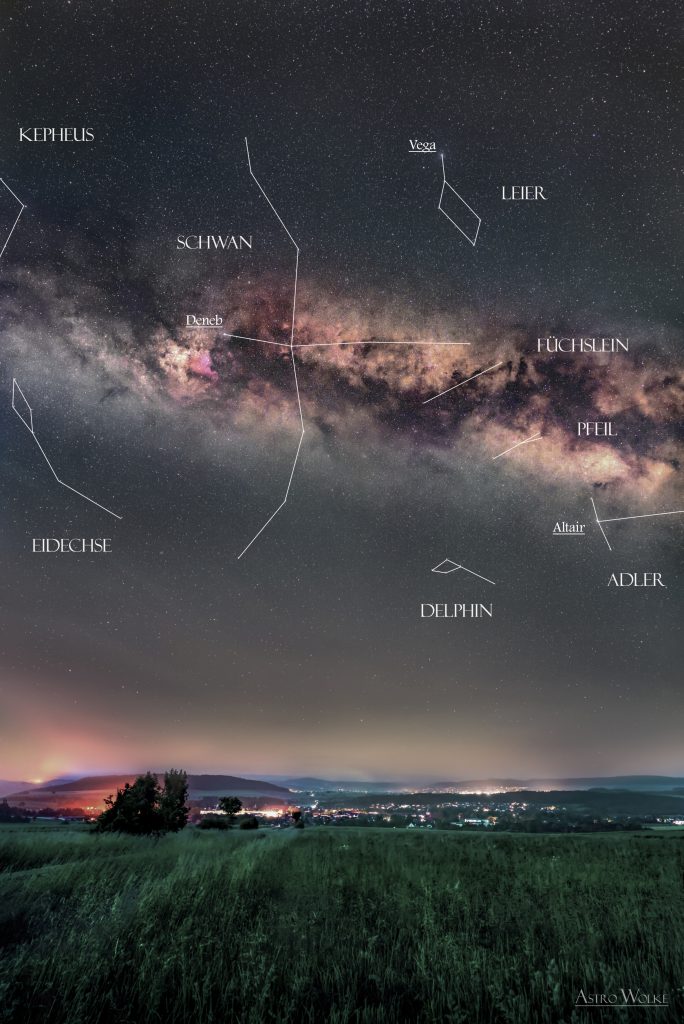
Details
Aufnahmedatum: 08.06.2026
Kamera: Sony Alpha 7III (ILCE 7M3)
Objektiv: Sigma 20mm F1.4 DG DN Art
Mount: Skywatcher Star Adventurer 2i
Belichtung: 30x60s
Blende: 2
ISO: 160
Bearbeitungssoftware: Sequator | Photoshop